


By Dr. Jill Kirk
With our organizational name of the Canadian Animal Shelter and Community Medicine Association, we are sometimes asked: What’s the difference between Shelter Medicine and Community Medicine? As someone who has spent almost 12 years as a shelter vet, who is now doing Community Medicine, I can say that it’s a very fine line.
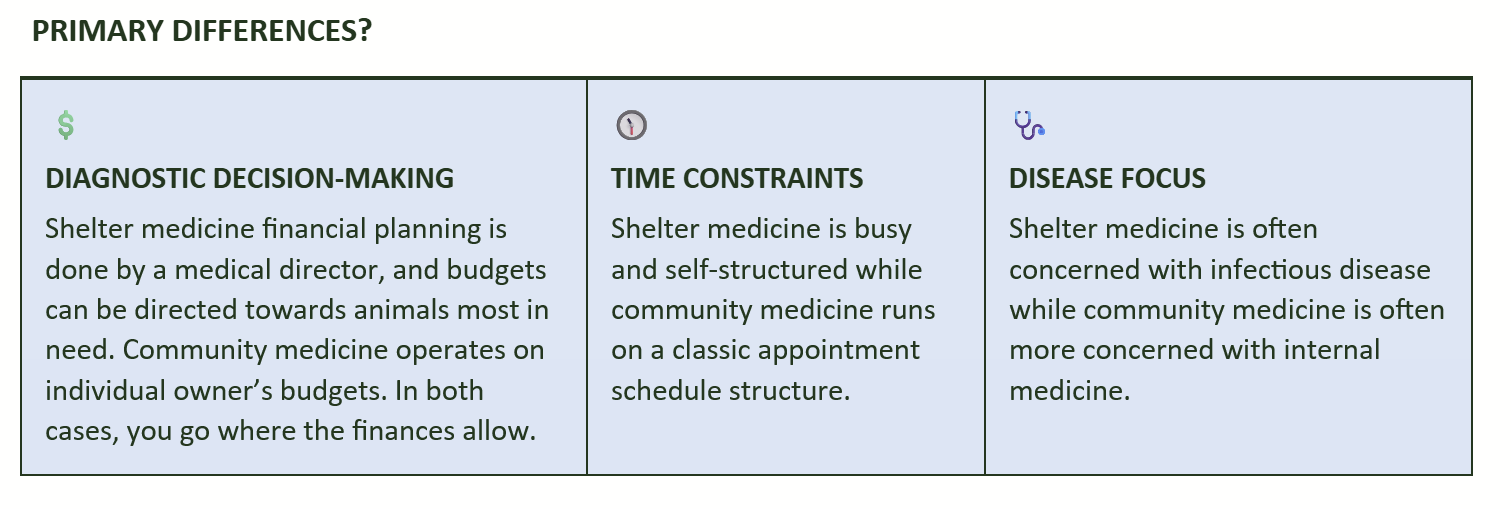

Perhaps the most obvious answer is who you have to run your diagnostics by- in a shelter it’s often the Medical Director or CEO who approves your finances. You can often go with a bit of a looser leash (pardon the pun) and run diagnostics on animals that truly need it without getting an explicit “ok”, so long as you’re not running thousands of dollars of tests. With community medicine, you have the owner’s often very limited budget to work within. Sometimes, in both worlds, you have to go without diagnostics and instead go with your best guess. Sneezing with green discharge? Let’s try some doxycycline. Urinating outside of the litter box in small puddles? Let’s give Clavamox a chance and see if that doesn’t resolve the issue. Neither usually has the funds for PCRs or cultures- and often the animals turn out just fine. You go where your finances allow – that is the same for both shelter and community medicine- the budget can only stretch so far.

Another difference is time allotments per patient. In the shelter, every day is busy, but usually no one is telling you the next patient is waiting. Usually it’s a mixture of surgery, medicine, intakes and foster rechecks, and depending on whether you are municipal or private, strays with any kind of injuries. In community medicine, often you have a 30 minute appointment to perform your exam, listen to the owner, recommend diagnostics, get an estimate, get your samples, run your samples, come up with a diagnosis, go over your treatment plan, get medication together and send them home. Meanwhile, two more appointments are waiting and five more are on the phone.

Shelter medicine is often more focused on infectious diseases, like parvovirus and panleukopenia, that can spread to the entire shelter (sometimes hundreds of animals). When those diseases occur in a community clinic, the concern is often much smaller, limited to just the one home they come from and potentially where that animal stepped while it was in the clinic. Community medicine tends to lean more towards internal medicine- these are sometimes animals that haven’t seen a vet for years and more often than not a “healthy pet exam” brings up lumps and limps and other questions. While community medicine may have limited history, at least they have an owner who can tell you what they see. Often animals in shelters come with no history, no age, no hint at what might be wrong- so you start from the beginning.

Neither practice is easy, and both are truly a calling. I know where my calling is, and where my preferences lie. I think they are both incredibly noble callings, and those who feel at home in either setting go home exhausted every day, hopefully feeling like they’ve done a good job, and all that they can for the animals they cared for that day. Then they wake up the next, ready to help more.